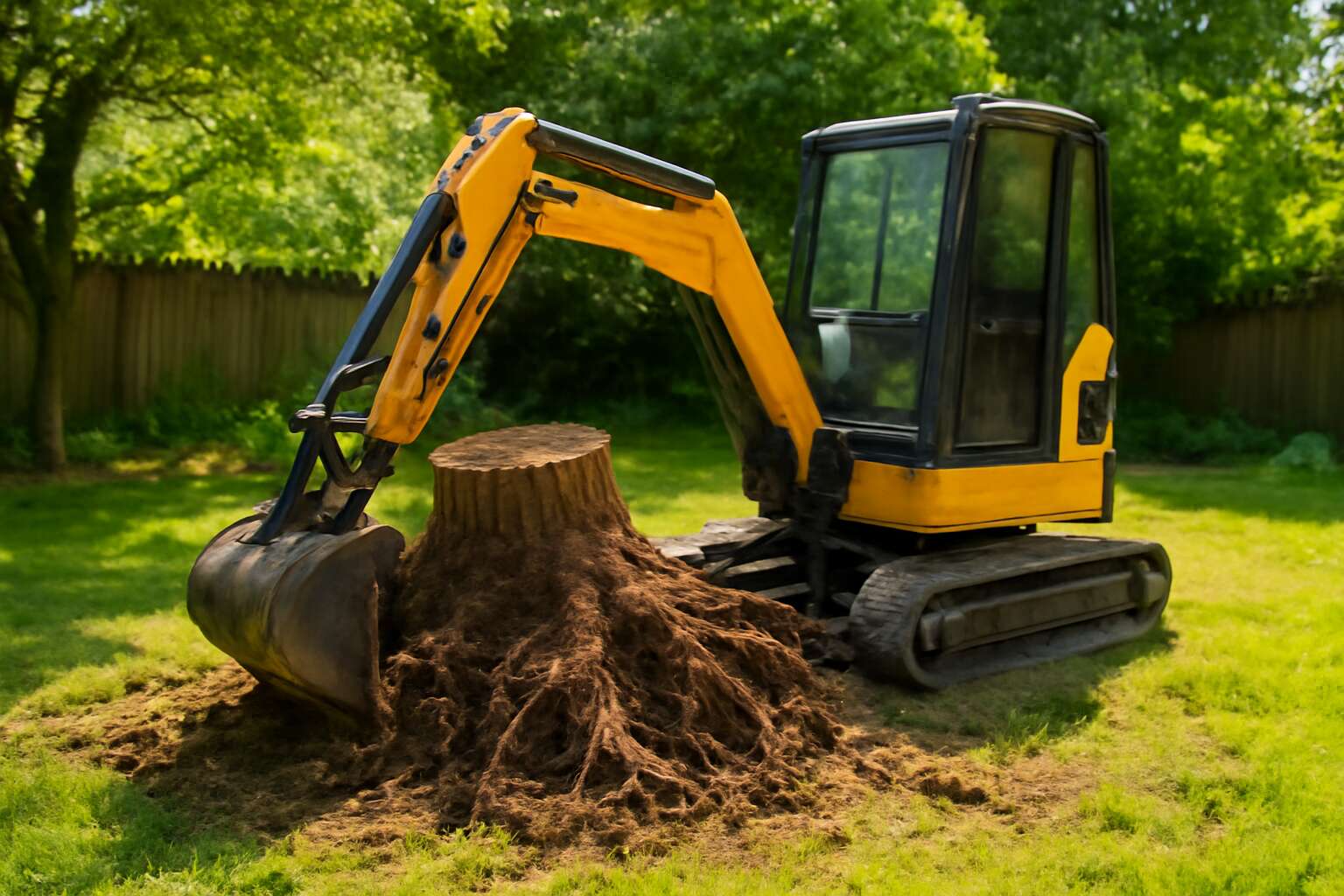
How excavator size affects stump removal outcomes
Impact of stump diameter and root spread on machine choice
Size matters on every stump job. What size excavator for stump removal? The right choice speeds work and protects the yard. A mismatch can leave stubborn roots and torn turf behind. Stump diameter and root spread guide machine selection and the approach on site.
To refine the choice, consider these factors:
- Stump diameter and trunk thickness
- Root spread and depth
- Soil type, moisture, and proximity to structures
With these dimensions in mind, machine selection becomes clearer. In South Africa, tight suburban plots often favor compact machines, while open sites can tolerate larger units. The aim is steady progress, minimal disruption, and a clean stump removal outcome!
How soil conditions influence digging depth and bite
Stumps are stubborn, and the ground tests every inch of patience! So, what size excavator for stump removal? The answer isn’t one-size-fits-all. I’ve seen yards breathe easier when the machine’s bite aligns with the root network, delivering steady progress without tearing turf.
Soil curiosity: moisture and texture decide the depth and bite of the dig. Consider these soil scenarios:
- Clay-heavy soils resist and demand gentler, shallower bites.
- Loose, moist sands invite deeper reach but can hide stubborn roots.
On South African sites, suburbia’s tight plots push toward compact machinery, while open fields tolerate larger silhouettes; the outcome rests on balance, rhythm, and a respect for the yard’s quiet living.
Reach, boom angle, and maneuverability requirements for tight sites
Stumps and precision are roommates in the SA yard. In tight suburb plots, the difference between a tidy withdrawal and a turf-marked battlefield comes down to reach, boom angle, and a calm inner rhythm. The right-sized excavator slides into the space like a well-mannered guest—polite on the power, ruthless with the root, delivering progress that respects the lawn and the neighbours!
Here’s how size plays out on the ground:
- Reach that clears the center of the stump without brushing fences or flower beds
- Boom angle flexibility to keep the bite clean and avoid collateral disturbance
- Maneuverability to pivot in a confined yard and retrace your path without a lumbering retreat
Ultimately, what size excavator for stump removal you choose hinges on context, not bravado. In South Africa’s tight plots, a compact performer often earns its keep.
Operator experience and safety implications in sizing decisions
In SA backyards, about 65% of stump removals go smoother when the excavator size matches the job—reducing turf drama and answering what size excavator for stump removal with practical clarity.
Operator experience isn’t a ego trip; it’s your insurance policy. A seasoned pro reads root spread, controls bite, and keeps safety margins intact.
- Smaller machines minimize turf damage and overreach risks.
- Trained operators maintain sightlines and controlled bites on roots.
- Right size keeps neighbours calm and hazards predictable during work.
In the end, size is situational, not swagger—the take-home is a yard spared, and a stump removed with dignity.
Key factors in selecting the right excavator size for stump removal
Assessing stump size, species, and root complexity
Stumps sleep beneath the surface like buried memories, and the question that rouses them is always the same: what size excavator for stump removal? I listen as the earth exhales. The answer weighs as much as the soil itself, measured not in inches but in the promise of quiet, patient extraction.
Key factors in selecting the right excavator size begin with Assessing stump size, species, and root complexity. Some species knit their roots like iron; others yield with time. The silhouette of the root ball—its mass, tangles, and stubborn grip—keeps a careful watch over your choice, even in South Africa’s varied soils!
Beyond the stump itself, the landscape speaks—soil, moisture, and the compactness of the surrounding turf whisper about maneuvering your fleet. That question, in that chorus, becomes a measured harmony rather than a gamble.
Site access, clearance, and working space
Access is the gatekeeper of a clean stump removal. When pondering what size excavator for stump removal, I listen for the quiet rhythm of space and constraint—the room to swing, the clearance to retreat, the patience to wait for roots to loosen their stubborn grip!
Site access, clearance, and working space are not afterthoughts; they are the compass by which the machine’s size is measured. Consider these essentials:
- Entry width and turning radius
- Overhead clearance and trench or eave obstacles
- Nearby structures, fences, and utilities
- Stability on soft ground or slopes
A narrow driveway or a cluttered yard can mute ambition, forcing a more measured approach that respects both ground and neighbors.
On South African sites, the ground beneath holds moisture, memory, and texture—sand, loam, clay—shaping how much space is truly available. Space becomes a moral boundary, guiding size by consequence, not appetite.
Soil type, moisture, and ground stability considerations
Ground truth beats stump size any day. Field intel from SA contractors suggests that more than two-thirds of delays come from unexpected ground moisture rather than the stump diameter. “The soil talks first,” a veteran operator reminds me, and what it says often narrows the list of candidates for what size excavator for stump removal. Size is a conversation with moisture and stability, not a vanity.
Soil type matters: sandy soils drain quickly but can shift; loam offers balance; clay stays soaked and heavier; surface water pockets increase risk. On moist days, ground stability dictates a lighter touch or smaller machine to avoid rutting or settlements. In short, your choice must respect both bite and balance when selecting for stump removal.
To gauge the right fit, consider these indicators:
- Soil texture and drainage
- Moisture content and seasonal variation
- Ground stability and slope risk
Required hydraulic reach and attachment compatibility
Facing the question what size excavator for stump removal, the answer unfolds as a dialogue between reach, balance, and the limits of space. In South Africa’s varied landscapes, the choice respects attachment ecosystems and the way a machine works with roots rather than ripping through them.
Key factors shaping the right fit go beyond stump diameter or ground texture. Think hydraulic reach, attachment compatibility, swing radius, and the ability to work neatly in tight spaces. The goal is a graceful bite that respects the land and the craft of the operator!
- Hydraulic reach and balance to cradle the stump and root ball
- Attachment compatibility with rotators, shears, and augers
- Swing radius and stability for confined or uneven sites
A well-chosen machine becomes a partner, turning stubborn stumps into a measure of craft rather than conquest.
Stability, travel on slopes, and grading constraints
Stumps test more than strength; they test judgment. When considering what size excavator for stump removal, stability on slopes often wins over reach. On many farms and urban yards across South Africa, terrain demands a patient, grounded approach—speed risks slippage and soil disruption. Up to 30% more time on site is not uncommon when the machine fights the ground.
Travel on slopes and grading constraints shape what fits. The machine must move with the land, not against it, so roots stay anchored and the surface remains intact.
- Stability on grades
- Travel on uneven terrain
- Grading constraints preserving soil and roots
With the right size, the operator becomes a craftsman. The stump yields to a partner that respects land, roots, and the rhythm of the site.
Common size ranges and best-use scenarios for stump removal
Mini excavators for small stumps and confined spaces
Stumps are stubborn reminders that every plot carries history. When you ask what size excavator for stump removal, the answer hinges on space, root mass, and the finish you require. In South Africa’s compact suburban yards, nimble machines often win before the first bite is taken—preserving fences and paving. Bigger isn’t always better; precision matters.
Common size ranges and best-use scenarios for stump removal unfold in practical tiers: mini excavators around 1-2 tons excel in confined spaces; 3-5 ton units balance reach with maneuverability for midsize stumps; 6-9 ton models bite deeper into stubborn roots, while 10-15 ton machines handle the tougher tasks where space permits. What size excavator for stump removal remains a site-specific call.
- 1–2 t: ideal for tight gardens
- 3–5 t: versatile for midsize stumps
- 6–9 t: heavy-duty bite
Compact excavators for yard work and moderate stumps
When asked what size excavator for stump removal, the answer hinges on space, root mass, and the finish you require. In South Africa’s compact yards, nimble machines spare fences and paving; bigger isn’t always better—precision and control win the first bite.
- 1–2 t: ideal for tight gardens
- 3–5 t: versatile for midsize stumps
- 6–9 t: heavy-duty bite
These ranges serve as practical guidelines for compact excavators used in yard work and moderate stumps. The right choice remains site-specific, shaped by yard geometry, accessibility, and attachment compatibility, ensuring efficient stump removal without disruption to the rest of the landscape.
Medium to large excavators for stubborn root systems and larger stumps
When stubborn stumps hold their ground, size matters—and the right balance of power and precision changes the game. For common yard removals in SA, medium to large machines cover a wide spectrum. What size excavator for stump removal? Generally, look to 10–18 t for the nimble middle ground and 20–40 t for stubborn, deep-root ventures.
In practical terms, the 10–18 t range handles midsize stumps with compact root systems efficiently and fits through normal access points; the 20–40 t segment powers through densest root mats and larger stumps where ground conditions permit. The key is matching reach, stability and the right attachment to the site—without inviting collateral damage.
Attachments and alternatives that extend capability (grinders, thumbs, rotators)
As South Africa’s yards evolve, a stubborn stump can be the difference between a usable lawn and a blank canvas. In practical terms, 10–18 t excavators strike a nimble middle ground for midsize stumps, while 20–40 t machines tackle deep root mats and larger stumps where ground allows. So, what size excavator for stump removal works best in your yard? The answer comes down to reach, stability, and the right attachment for the site.
Attachments extend capability beyond raw mass, unlocking cleaner cuts, safer handling, and steadier maneuvering on variable ground! A few dedicated add-ons widen the practical range for stump work.
- Stump grinders
- Hydraulic thumbs
- Rotators
Ultimately, site conditions and attachment compatibility guide the final mix, balancing reach, stability, and the overall vibe of a yard that’s ready for transformation.
When to rent or hire a larger machine for efficiency
Stump removal has a surprising psychology: the stubborn obstacle that stands between a lush lawn and a blank canvas! In many SA yards, removing a stump can unlock up to 60% more usable space once the roots are coaxed free. So, what size excavator for stump removal suits your yard?
Common size ranges offer a clean ladder of capability for different stump profiles. We see a few reliable categories:
- Mini excavators under 5 t: ideal for tight spaces and shallow rooting systems.
- Compact 5–10 t: versatile for moderate stumps in a suburban yard.
- Midsize 10–18 t: balanced reach and stability for stubborn root mats.
- Large 20–40 t: the pick when ground allows and stumps root deep.
Ultimately, determining what size excavator for stump removal works best is a function of space, root complexity, and attachment compatibility.
Practical decision framework and examples for excavator sizing in stump removal
A step-by-step sizing checklist for your site
Across South Africa’s varied landscapes, the stubborn stump is more than a nuisance—it’s a compass guiding your gear choice. A recent study shows stump delays can double project time if gear is misread. When you ask what size excavator for stump removal, you’re weighing power, reach, and site quirks in one breath. The answer grows from a practical frame, not a guess.
Begin with a pragmatic framework: match stump size and root complexity to machine mass, then weigh site access and attachment compatibility. For instance, a compact yard stump invites a nimble machine; a gnarly cascade of roots near a boundary may demand more reach and controlled torque.
- Site access: width, clearance, and surface stability?
- Required reach and digging depth to clear safely?
- Attachments and machine compatibility with the stump?
It’s a careful balance, and the decision feels almost magical—until the numbers tell the truth.
Real-world scenarios with recommended sizes
Practical decision framework starts with a simple arithmetic: stump size and root complexity mapped to machine mass, then tested against site access. When you ask what size excavator for stump removal, the answer isn’t guesswork—it’s a calculation of reach, torque, and control. In South Africa’s varied yards, the choice becomes a dialogue between stump reality and the geometry of your site.
Real-world scenarios guide the numbers. Consider these representative sizing decisions that feel almost cinematic in the field:
- Urban backyard stump, 20–25 cm diameter, soft soil: a compact 3–5 ton excavator offers nimble handling.
- Stump near a boundary or fence requiring reach and torque: a 6–9 ton machine balances control.
- Large, stubborn stump on uneven ground: a 15–20 ton excavator delivers depth and force.
Safety, training, and operator qualifications to consider
South Africa’s sunlit yards demand a precise union of reach and restraint. The question what size excavator for stump removal isn’t guesswork but a calculation of reach, torque, and control. I’ve watched a 3–5 ton rig coax stubborn roots with calm efficiency.
Practical decision framework treats stump reality and site geometry as partners. Safety, training, and operator qualifications anchor every sizing choice, reminding us that a machine’s bite must be matched by skill and stewardship on the ground.
- Qualified operators with current SA certifications and site-specific briefings
- On-site risk assessment and a competent person supervising operations
- Regular maintenance, PPE compliance, and clear communication protocols
Here in SA yards, the dialogue between stump reality and site geometry resolves into safer, cleaner outcomes for property owners and neighbors alike.
Cost, downtime, and productivity trade-offs in sizing decisions
The question what size excavator for stump removal isn’t guessing—it’s a calculated fit. In South Africa, pairing reach with control matters more than raw horsepower. Size should trim downtime, protect landscapes, and keep neighbours happy.
Practical decision framework treats stump reality and site geometry as partners. Here are the trade-offs that drive sizing choices:
- Cost: rental vs ownership, fuel, maintenance, and resale value.
- Downtime: mobilization, site prep, and access constraints that slow work.
- Productivity: attachment options, digging speed, and cycle time per stump.
Examples anchor the thinking: in tight yards, a 3–5 ton rig hits the sweet spot for moderate stumps. On open ground with stubborn roots, plan for a larger machine and suitable attachments. The final call must align with site access and operator capability.

0 Comments