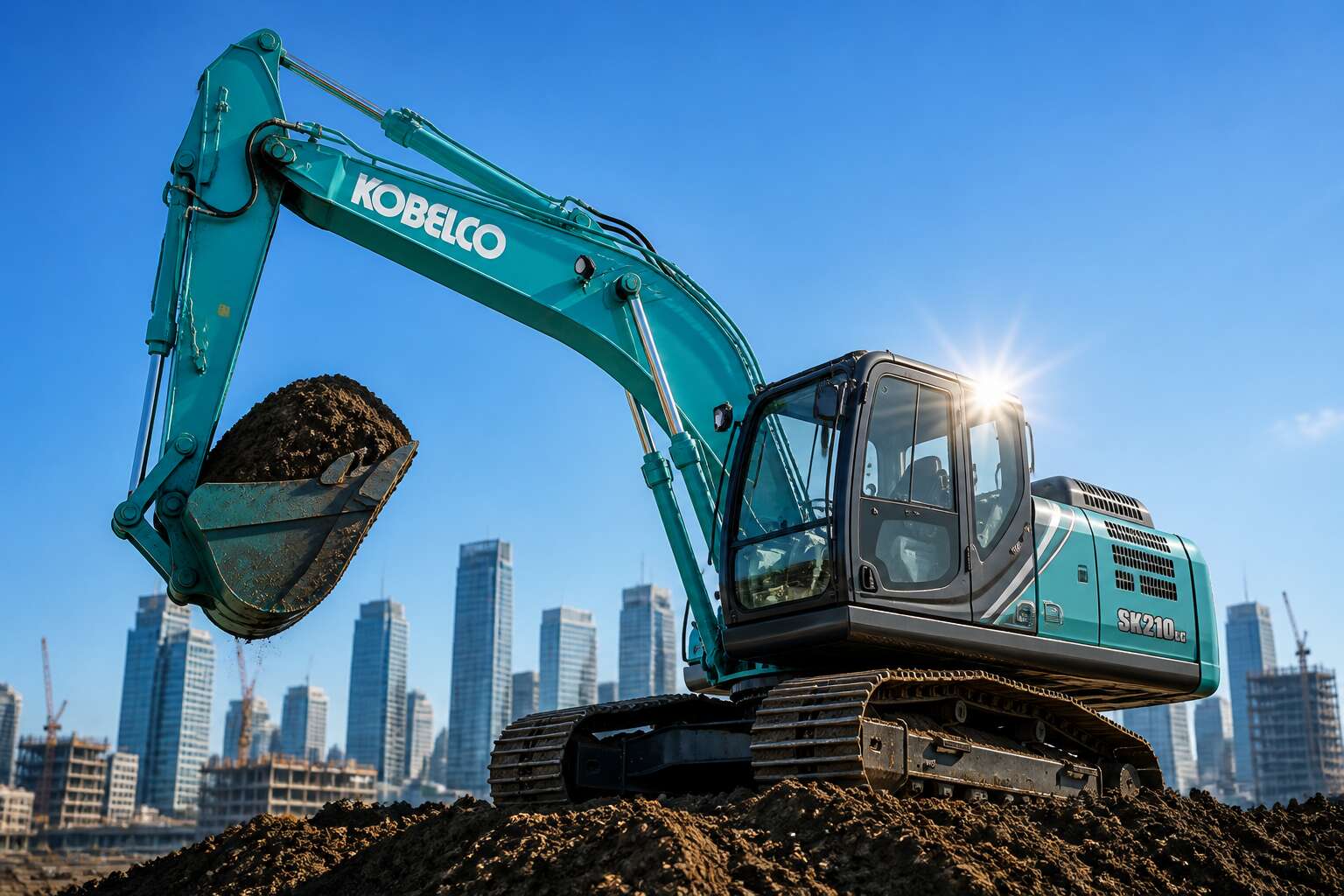
Brand Heritage and Global Impact
Origins of the Kobelco Name and Engineering Legacy
The Kobelco name derives from Kobe Steel and Shibaura, two houses that merged in 1905. That union combined metallurgical mastery with mechanical engineering. Every kobelco excavator traces its lineage to that fusion.
This legacy is not nostalgia. It is a practical inheritance of stress-testing and material science. In South Africa, where rock and heat punish equipment, this heritage shows up in reinforced booms and dependable hydraulics.
- First generation machines focused on structural weight reduction.
- Later designs integrated electro-hydraulic control for precision.
- Modern units prioritise fuel economy without sacrificing power.
Global impact followed naturally. From Japanese city sites to African open pits, the badge has earned a reputation for longevity. I have seen these machines working years beyond their expected lifespan! That is the true measure of the name.
Expansion of Manufacturing Facilities Worldwide
The global footprint of the Kobelco excavator has grown far beyond a single assembly line. Manufacturing plants now operate across multiple continents, each one calibrated to the demands of its region. This expansion means a machine built for the Japanese market receives different final touches than one destined for African soil. The core engineering remains constant, but the application shifts with local conditions.
This dispersal of production has created an interesting dynamic for buyers. A kobelco excavator sourced from a nearby plant carries shorter lead times and more responsive service channels. Parts availability improves when the factory sits closer to the job site. For South African operators, this translates to reduced downtime and easier maintenance planning.
The expansion also enabled a transfer of technical knowledge into emerging markets. Local technicians trained at these plants bring a deeper understanding of the equipment back to their communities. The global network functions as a learning organism, not merely a distribution chain.
What this means for the contractor in Mpumalanga or the dealer in Gauteng is straightforward:
– Reduced shipping costs and faster delivery schedules
– Regional parts inventories that prevent long idle periods
– Service teams with direct factory training
– Warranty support that honors the brand promise locally
The manufacturing footprint now shadows the machine’s usage patterns. Wherever heavy industry operates, a production facility sits within reasonable reach. That proximity benefits the end user who needs a replacement hydraulic pump or a new boom assembly without waiting weeks for international freight.
I have watched the brand grow from a regional powerhouse into a global supplier without losing its commitment to robustness. The kobelco excavator remains a fixture across African mining operations precisely because the company scaled its manufacturing intelligence, not just its output. That distinction matters when your machine sits in a dusty pit under a blazing sun.
Key Milestones in Excavator Development
In 1961, Kobelco unveiled its first hydraulic excavator, a machine that redefined digging power for its era! That debut set a standard for precision engineering. Over six decades, the model line evolved through relentless refinement, not revolution for its own sake.
- The 1970s brought the LE series, which introduced electronic control systems.
- The 1990s saw the development of the SK series, enhancing fuel efficiency.
- The 2010s focused on hybrid technology, cutting emissions by a third.
These milestones shaped a global reputation for durability. In South African quarries and construction sites, the brand’s heritage translates to machines that handle abrasive conditions. The kobelco excavator carries a lineage of practical innovation, and I have seen operators measure that trust in years, not hours.
Kobelco’s Role in Major Infrastructure Projects
Every major infrastructure project has a moment when the ground must yield. Kobelco excavators have worked on harbour expansions and power station foundations, in conditions that test metal and patience. In South Africa, the machines appear on roadworks and mine haul roads, where hydraulic precision matters more than raw speed.
Consider the discipline required: one operator error near a buried pipeline can halt a week’s schedule. That is why contractors trust the kobelco excavator for controlled, deliberate excavation. The global footprint includes bridges in Southeast Asia and water systems in the Middle East, but the principle remains the same. Reliability is a pattern of behaviour under pressure.
- Durban port expansion
- N3 highway upgrades
- Mpumalanga coal mines
These jobs are not glamorous. They are continuous, unforgiving work. That is where heritage proves itself.
Market Presence Across North America, Asia, and Europe
Walk onto a jobsite in Texas or Tokyo and you will see the same dependable silhouette. The kobelco excavator has earned its place on three continents through decades of consistent performance. North American contractors value the fuel efficiency and precise hydraulic control for utility work. Asian markets rely on the compact radius for urban demolition and tight footprint projects. European operators appreciate the emission compliance and low noise profiles in residential zones.
The brand heritage carries weight in procurement decisions. When a fleet manager in Germany or Canada specifies a kobelco excavator, they reference a lineage of reliability that transcends borders. My own visit to a Dutch rental yard confirmed this. The owner pointed to a decade old unit still running original hydraulics!
This global footprint creates a support network. Parts availability and service expertise follow the machines wherever they work. For South African operators, that means the same engineering standards that satisfy Tokyo or Berlin are available in Johannesburg.
Technological Innovations and Smart Features
Hybrid and Electric Drive Systems
Industry data suggests hybrid drive systems can cut fuel usage by up to 20 percent on typical loading cycles. For South African operators battling diesel costs and load shedding, that is a significant shift in operational economics!
The kobelco excavator now integrates smart telematics that stream hydraulic pressure and engine load data to your phone. Site managers can predict component wear instead of reacting to failures. Hybrid drive blends an electric swing motor with a conventional diesel engine, recovering kinetic energy that older machines simply lost.
Key innovations include:
- Regenerative swing circuits that recharge the battery
- Adaptive control valves that reduce hydraulic shock
- Eco mode that adjusts pump flow automatically
The latest kobelco excavator models also offer electric drive attachments for enclosed spaces. They produce zero local emissions, vital for urban demolition projects. The software learns operator habits and suggests throttle settings to minimize aggressive movements, prolonging component life.
Next-Generation Hydraulic Circuitry
What impresses me most about the latest kobelco excavator isn’t the raw horsepower, but the intelligence packed into its hydraulic heart. The new circuitry uses electronically controlled variable displacement pumps that match flow to demand with millisecond precision. This means no wasted energy when you crack a bucket into hard ground, only the exact force required for the job.
For South African sites battling extreme heat and altitude, the system self-calibrates. It compensates for thinner air and higher oil temperatures, keeping cycles smooth. The pressure sensing valves reduce cavitation, which extends seal life considerably.
- Independent boom and arm metering
- Load-sensing hydraulics that prevent flow robbing
- Adaptive damping to reduce stress on the boom assembly
These advancements translate into better fuel economy and less wear on the machine, which is crucial when every rand counts. The kobelco excavator now feels less like a brute tool and more like a precise instrument, one that respects the operator’s skill while forgiving his oversights.
Machine Control and GPS Integration
On South African sites, a kobelco excavator with factory integrated machine control brings a new level of confidence. The 3D GPS guidance positions the bucket precisely, allowing a newer operator to cut a clean trench or reach a steep grade on the first pass. The old reliance on string lines and pegs starts to fade.
The system uses satellite corrections and onboard sensors to track the boom, arm, and bucket in real time. The cab display overlays the digital terrain model, and the machine adjusts itself to avoid undercutting. Fewer passes burn less fuel and disturb the ground less, a real benefit on environmentally sensitive sites.
- Real time depth and slope accuracy that reduces manual survey work.
- Remote telematics to monitor fuel and machine health from a phone.
- Geofencing to track a kobelco excavator across multiple project areas.
These features let you focus on running the site while the machine handles its own precision.
Telematics and Remote Diagnostics
Consider this: a single telematics fault code can save a South African contractor upwards of R40,000 in unplanned downtime. That is the benefit of remote diagnostics on a modern kobelco excavator! The machine’s ECU streams hydraulic pressure, coolant temperature, and fuel burn data to a secure cloud portal, where predictive algorithms flag anomalies long before they become mechanical failures.
Site managers in Gauteng or the Cape can pull live engine hours and idle ratios from their phones, while the system cross-references component wear against regional operating conditions. A kobelco excavator equipped with these smart features delivers diagnostic granularity that shortens service intervals and extends asset life.
- Fault code alerts with recommended corrective actions
- Historical performance logs for warranty and resale documentation
- Remote software updates that avoid dealer call-out fees
For fleets scattered across multiple provinces, this telemetry converts reactive repairs into scheduled interventions!
Emission Reduction and Eco-Mode Technologies
Emission reduction on a modern kobelco excavator goes beyond meeting legislative thresholds. The variable speed cooling fan and five stage fuel injection system trim parasitic losses, so every litre of diesel performs measurable work. In eco mode, the hydraulic pump output is matched to joystick input in real time, which lowers fuel burn without sacrificing breakout force.
Operators on South African sites can monitor the regeneration cycle of the diesel particulate filter through the in cab display. This data informs shift planning, preventing unplanned regens during peak production hours.
- Auto idle and auto shutdown reduce unnecessary engine runtime
- Eco mode adjusts swing torque for light duty applications
- Selective catalytic reduction cuts NOx emissions by up to 90 percent
Automation Features for Precision Digging
Precision digging on a modern kobelco excavator is no longer solely dependent on the operator’s hand eye coordination. The machine’s onboard sensors continuously measure boom angle, arm extension, and bucket orientation. That data feeds a controller which compensates for hydraulic lag, delivering smoother, more accurate cuts even in uneven ground.
Automation features now extend to semi autonomous cycles. For repetitive trenching, the excavator can reproduce a defined depth profile after a single manual pass. This reduces operator fatigue and maintains consistency across a full site.
- Bucket angle sensors provide real time tilt feedback
- Automated swing damping prevents bucket spillage during rotation
- Depth limit alarms alert the operator before over excavation
These systems do not replace skill, but they augment it. A kobelco excavator becomes a precision tool that transforms experienced judgement into measured, repeatable output.
Model Lineup and Application Suitability
Compact Excavators for Tight Urban Spaces
Cape Town’s narrow lanes and Johannesburg’s congested sites demand machines that slip through gaps a human could barely navigate. The kobelco excavator range for compact duties answers this with reduced tail swing and precise hydraulic response. Models like the SK17SR and SK35SR offer zero tail swing configurations, allowing operators to work flush against walls and foundations.
These machines are not scaled down versions of larger units. They carry reinforced booms and independent travel pedals for delicate manoeuvring.
- Short counterweight radius for enclosed excavations
- Auxiliary piping for hydraulic attachments
- ROPS canopy options for low clearance sites
Operators in Durban’s heritage districts rely on this agility. The kobelco excavator’s compact footprint converts restricted plots into viable workspaces.
Mid-Size Models for General Construction
Mid-size models occupy a practical middle ground. The SK140 and SK170 handle bulk earthworks on Gauteng housing developments without requiring a fleet of support vehicles. Operators appreciate the balance between digging force and fuel burn, and the kobelco excavator delivers both without fuss.
These machines manage sewer reticulation, stormwater drainage, and foundation trenches. The SK210 performs strongly on road construction sites. Its variable displacement pumps match hydraulic flow to the task, reducing wasted energy.
Common configurations include:
– Monobloc booms for general digging
– Two-piece booms for demolition work
– Long undercarriages for stability on soft ground
Powerplants meet Tier 4 emission standards while maintaining service intervals that keep machines on site, not in the workshop. In my experience, that reliability matters more than raw specs when deadlines loom.
Short Tail Swing Excavators for Roadwork
When roadworks close a lane on the N1, space becomes the deciding factor. Short tail swing excavators from the kobelco excavator range rotate within their own footprint, letting crews work beside live traffic without shutting down adjacent lanes. The SK55SRX and SK75SRX fit this role well. Their reduced counterweight swing radius keeps the machine clear of barriers and passing vehicles.
Operators on Gauteng road projects use these machines for kerb setting, culvert installation, and shoulder regrading. The boom design provides reach across trench boxes while the machine stays parked parallel to the worksite. Service points remain accessible from ground level, which matters when every minute of lane closure carries a penalty. The kobelco excavator configuration here prioritises compact rotation over raw breakout force.
Common fitments include:
- Rubber tracks for asphalt surfaces
- Offset booms for working tight against walls
- Quick couplers for swapping buckets between tasks
Large-Scale Mining and Quarrying Machines
When the scale shifts from kerbside to quarry face, the kobelco excavator lineup answers with a different kind of machine. On South African open cast mines and aggregate quarries, the larger classes carry the burden of daily production. These units, such as the SK500LC and SK850LC, deliver breakout forces measured in tonnes. Their reinforced booms and heavy duty undercarriages absorb the punishment of loading blasted rock into articulated dump trucks.
Operators in the Mpumalanga coal fields and Gauteng quarries rely on these machines for face loading, secondary breaking, and high volume excavation. The kobelco excavator in this class features:
- Dual element air cleaners for dusty conditions
- High ambient cooling packages for summer heat
- Reinforced track guards for rough terrain
These fitments keep the machine alive through three shift cycles, where downtime costs more than the machine itself.
Operating Costs and Fuel Efficiency
Fuel Consumption Benchmarks Across Load Cycles
Fuel consumption often determines whether a project stays profitable. For a kobelco excavator, the difference between a short-cycle truck loading job and a long, sweeping trench cut can shift hourly fuel burn by nearly 30%. That variance is the true benchmark, not the brochure figure.
In practice, you see specific patterns across load cycles. A kobelco excavator sitting in idle while waiting for haulers burns roughly 3 to 4 litres per hour. Meanwhile, a heavy digging cycle in hard ground pushes consumption toward 18 to 22 litres per hour on mid-size models. The real cost is in the transition: frequent throttle changes and partial loads waste more than steady, matched operation.
- Light grading: 8 to 10 litres per hour
- General trenching: 12 to 15 litres per hour
- Rock excavation or truck loading: 18 to 22 litres per hour
These numbers matter for operational planning. When you match the machine’s output to the cycle demand, you stop burning fuel on empty motion. Track the litres per hour against the actual cubic metres moved, and you get a cost per unit of work, not just a pump bill.
Cutting-Edge Engine Technology and Emission Standards
Operating costs go beyond the fuel gauge. A kobelco excavator carries engine technology that shapes every litre burned on site. In South Africa, where diesel prices swing with global markets and logistics, that efficiency directly impacts tender margins. Modern emission standards force cleaner combustion, but they also change maintenance intervals and fluid specifications. These factors shift the true cost per hour.
Consider what drives your operating budget:
– Fuel quality and filtration requirements
– Diesel exhaust fluid consumption on newer models
– Service intervals tied to emission systems
– Idle management strategies across multiple machines
Each line item is controllable, but only when you understand how the engine and aftertreatment work together. A kobelco excavator with well maintained emission components holds its fuel curve closer to the factory spec. That stability makes cost forecasting reliable over a 10,000 hour lifecycle.
Total Cost of Ownership and Resale Value Analysis
Most buyers calculate the purchase price, but the serious number sits in the rands per hour ledger over a decade. A kobelco excavator with disciplined fuel management returns that early investment many times over. When auction day arrives, the difference between a trade-in and a premium price comes down to the paperwork proving those efficiencies.
The South African used market rewards buyers who understand total cost of ownership. Fuel efficiency determines whether you bid on tenders with confidence or watch margins erode. Hydraulic efficiency and engine calibration compound into thousands of litres saved per year.
What the used market actually checks:
- Service records matched to hour meter readings
- Fuel consumption logs that align with load cycles
- Undercarriage wear patterns consistent with site conditions
When resale time comes, a kobelco excavator with verifiable maintenance history attracts buyers willing to pay above book value. That resale strength sits at the core of any total cost of ownership calculation.
Maintenance Best Practices and Common Repairs
Pre-Start Inspection Checklists for Operators
A five minute pre-start inspection is a five figure repair bill avoided. That is the quiet arithmetic behind every well maintained kobelco excavator. Operators who skip the ritual eventually meet the cost.
Work through the usual suspects before the engine turns over:
– Hydraulic oil level and condition
– Track tension and worn sprockets
– Leaks around the swing motor and final drives
– Grease points on the boom and bucket linkage
Common repairs on older units revolve around perished hoses, seized pins, and tired hydraulic pumps. Most of these failures announce themselves early, through a low fluid level or a telltale streak of oil. The kobelco excavator gives plenty of warning, provided someone is actually looking. A daily check beats a monthly breakdown.
Hydraulic Fluid and Filter Replacement Intervals
The hydraulic system carries the full working life of a kobelco excavator. South African conditions, with their heat and dust, punish hydraulic fluid harder than temperate climates do. Operators running machines in Mpumalanga coal fields or Western Cape quarries need to track service hours carefully.
Standard intervals for hydraulic oil sit around 2,000 hours, but filter changes demand more attention. Return filters often need replacement at 500 to 1,000 hours depending on the environment.
- Sample the fluid at every oil change
- Check the breather filter for clogging
- Inspect suction strainers when performance drops
- Record water content in the reservoir
Contaminated fluid does more damage than a worn pump. The kobelco excavator’s hydraulic circuit tolerates minor deviation briefly. Oil that smells burnt or appears milky will fail components quickly.
Undercarriage Wear Management and Track Tensioning
Track tensioning deserves daily attention, not weekly guesswork. A kobelco excavator working Transvaal dolomite or Karoo gravel will punish loose chains. Tension that is too tight strains sprockets and idlers; tension that is too loose lets the track slap and accelerate pin wear.
Check track sag midway between the idler and sprocket, and measure with the machine off the ground! Grease the tensioner slowly, watching for leaks around the recoil spring.
Common repairs on undercarriages:
- Replace worn sprocket teeth before they hook.
- Inspect track links for hairline cracks.
- Rotate idlers when flats appear.
- Replace bolts that show stretch or rust.
These steps prevent costly downtime. A well maintained undercarriage on a kobelco excavator can extend component life by thousands of hours.
Cooling System Maintenance and Overheating Prevention
A kobelco excavator working under the Free State sun pushes coolant through its block at a rate measurable in litres per minute. When that flow drops, temperatures climb and the engine labours. Radiator fins clog with dust and grass seeds in a single shift. Compressed air blown from the inside out clears them without bending the cores. Check the coolant mixture with a refractometer, not a glance. Water alone invites cavitation damage in the cylinder liners.
- Perished hoses that collapse under suction
- Radiator caps that no longer hold pressure
- Fan belts with glazed surfaces
- Clogged coolant filters on larger models
A kobelco excavator that runs hot burns more fuel and wears its head gasket faster. Addressing these repairs early keeps the machine reliable through a long South African summer.
Diagnosing and Clearing Common Error Codes
Many fault codes trace back to bad connections, not failed components. In our experience, wiring corrosion and chafed harnesses cause a large share of sensor faults on a kobelco excavator. Trace the circuit before replacing parts. Measure continuity at the connector, inspect the pins for green corrosion, and check the earth point under the cab floor. Clear the code after the repair, then run the machine through a full digging cycle. A code that returns under load indicates a genuine condition, often an intermittent short.
Common diagnostic work falls into familiar patterns:
- Fuel pressure or injector circuit faults
- CAN bus communication dropouts
- Hydraulic sensor readings out of range
Each requires the same discipline. Skipping the diagnosis guarantees the code returns.
Seasonal Storage and Long-Term Preservation Tips
A kobelco excavator parked for the off season can suffer more damage than one running double shifts. The South African rainy season accelerates mechanical failure. Before idle months, cycle every hydraulic cylinder to full stroke, lower the bucket and rest it on timber. This releases pressure on rod seals and stops water ingress. Grease every pivot until fresh grease weeps from the old, because moisture becomes grinding paste.
Battery care is straightforward. The telematics unit draws parasitic current, so disconnect the negative terminal. Fill the diesel tank to prevent condensation and add biocide. Then follow the seasonal checklist!
- Drain the water separator and inspect for sediment.
- Seal the exhaust with a weatherproof cap.
- Cover cab air vents against rodents.
Coastal operators must coat track adjuster rods on a kobelco excavator with corrosion inhibitor. Salt air seizes them within weeks. When the machine returns to work, warm the hydraulic oil first.


0 Comments