Understanding the Hydraulic Breaker (Often Called a Pecker)
Definition and Working Principle of an Excavator Breaker
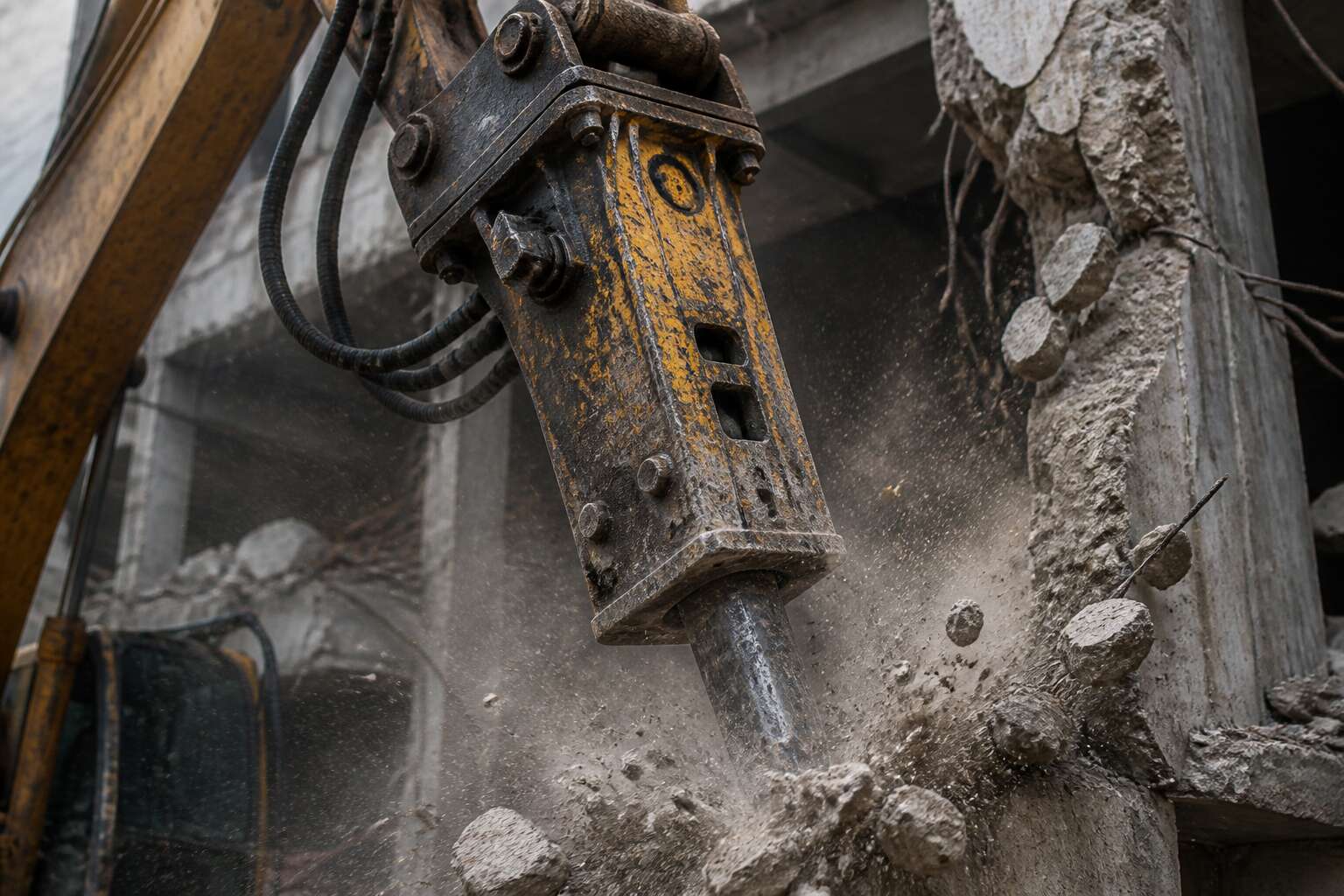
A hydraulic breaker, often called a pecker on South African job sites, is a percussive attachment for excavators. It converts hydraulic pressure into impact energy to break concrete, rock, and asphalt. The nickname comes from the rapid up-and-down pecking motion of the steel chisel.
The working principle is straightforward. High-pressure hydraulic oil drives a piston upward, compressing nitrogen gas in an accumulator. When the piston releases, the gas forces it downward with force, striking the chisel. This sends a shock wave into the material. Each blow shatters the surface, and repeated strikes deepen the fracture.
For operators, an excavator with pecker attachment demands proper technique. You need to maintain the correct angle and pressure, otherwise you risk damaging the carrier or the breaker itself. Regular greasing of the chisel is essential.
Hydraulic vs. Pneumatic Breakers: Key Differences
Pneumatic breakers are the noisy neighbours of the demolition world, demanding a separate compressor and a budget for earplugs. Hydraulic units? They are the strong, quiet performer. For an excavator with pecker, the choice is obvious. Pneumatic models lack the sustained punch needed for hard rock, while hydraulic systems draw directly from your carrier’s engine power. Consider these points:
- Pneumatic: Needs an external air supply, ideal for shallow patches, but efficiency drops drastically under load.
- Hydraulic: Uses the excavator’s own oil pressure, delivering consistent, high-impact force without extra machinery.
The real kicker? Pneumatic breakers lose power the longer the hose runs. Hydraulic keeps hitting hard. So when you spec an excavator with pecker for a serious job, skip the compressor. Your backhoe will thank you, and so will your accountant.
Why the Term ‘Pecker’ Is Common in Construction
The term pecker might raise an eyebrow. In construction, it is the standard nickname for a hydraulic breaker on an excavator. The name comes from the pecking motion of the steel tool as it breaks concrete and rock. An excavator with pecker delivers force in short strokes.
Why did this nickname stick? It is descriptive and easy to say on a noisy site. A worker calls for the pecker, not the hydraulic impact hammer. The tool bobs up and down with short strokes.
- It turns a digger into a breaker.
- It removes the need for a secondary power unit.
- It offers controlled breaking in tight spaces.
The name may be playful, but the work is serious. The excavator with pecker is key for urban renewal. It turns a simple machine into a force. Listen for the rhythmic thud, and you will know it is at work.
How the Attachment Mounts onto Different Excavator Sizes
Rental yards in South Africa report that most hydraulic breaker attachments fit machines from 1.5 to 20 tonnes. A mismatch damages both the carrier and the tool. The mounting bracket is a simple steel box that slides onto the dipper arm. The breaker’s side pins lock it in place. Couplers for high flow and return lines connect the hydraulic circuit.
On mini excavators, the pecker often mounts sideways because the arm geometry lacks room. On larger machines, the same pecker sits square and central. This position gives more leverage and impact energy. I have seen a 3 tonne excavator with pecker flick a kerb stone loose without straining! The flow of the oil matters more than the size of the boom.
Critical Factors for Selecting the Right Breaker for Your Excavator
Matching Breaker Weight to Excavator Tonnage
Selecting the correct attachment for an excavator with pecker operations in South Africa starts with weight. The breaker must align with the carrier’s operating tonnage. Oversized units cause hydraulic strain and reduce the machine’s stability. Undersized breakers struggle against the dense dolerite found in the Free State or the quartzite of the Witwatersrand.
A precise match ensures the pecker operates at optimal impact speed. The carrier’s static and dynamic lifting capacities dictate the available options. Hydraulic flow rate and pressure at the boom tip must fall within the breaker’s specified range. The manufacturer’s technical sheet provides a working range for each breaker model. The middle percentile suits standard digging conditions. Ignoring these figures forces the attachment to work beyond its designed cycle rate. This leads to premature wear on the hammer and the boom joints. A local dealer can calibrate nitrogen gas pressure for high altitude sites, such as those around Gauteng. Correct matching lowers the cost per broken tonne. This matching also extends the lifespan of the excavator with pecker.
Evaluating Impact Energy and Blows per Minute
Impact energy and blows per minute are the two numbers that reveal how a pecker performs on site. Impact energy, measured in joules, drives each strike. Blows per minute controls how often that force lands. Getting both right separates a productive excavator with pecker from one that just makes noise.
Hard rock like dolerite or quartzite demands high impact energy over speed. A breaker delivering 1,000 joules at 500 BPM outperforms one delivering 500 joules at 900 BPM in tough ground. Soft materials respond better to rapid blows.
- Match impact energy to rock type, not machine size
- Check BPM against the carrier’s hydraulic flow rate
- Verify stated figures on a test rig
Ignoring these factors causes bouncing on hard rock or over-pulverising soft ground. Both waste fuel and wear the carrier. The right balance keeps the excavator with pecker efficient across Joburg and Free State sites.
Required Hydraulic Flow and Operating Pressure
Most operators check a breaker’s weight but ignore the carrier’s hydraulic appetite. Required hydraulic flow and operating pressure are the real gatekeepers. Your excavator with pecker needs a flow range that matches the breaker’s spec sheet. Too little flow gives you a lazy thud. Too much flow turns the attachment into a demolition tantrum.
The carrier’s relief valve settings matter more than brand names. A mismatch between pump output and breaker demand causes overheating, seal failure, and a pecker that performs like a confused jackhammer. Measure actual flow under load, not idle readings. Joburg’s hard ground punishes guesswork.
– Flow rate in litres per minute must sit inside the breaker’s window
– Operating pressure in bar must align with the carrier’s hydraulic system
– Check both at working temperature, not cold start
An excavator with pecker that screams at high pressure while starving on flow will cost you a fortune in downtime. Get the numbers right before you buy.
Top Applications and Operational Benefits of Using a Breaker Attachment
Demolition, Concrete Breaking, and Foundation Removal
In South African demolition, the excavator with pecker is the preferred attachment for structural dismantling. Its applications include demolishing reinforced concrete slabs and extracting stubborn foundation piles. The operational benefits are decisive: it applies focused, high-impact pressure that breaks material without damaging surrounding services.
Consider these advantages on a typical Johannesburg site:
– It removes the need for explosives, reducing blast clearance zones.
– It enables selective chipping for precise demolition, preserving steel rebar.
– It functions well in narrow urban spaces where larger equipment fails.
Furthermore, the excavator with pecker lowers dependence on handheld breakers, reducing worker fatigue and speeding up project schedules. For foundation removal, its capacity to shear through mass concrete and embedded rebar is critical. This attachment makes a standard excavator a versatile breaking tool for demolishing, reshaping, and clearing, ensuring productive use of every working hour.
Rock Excavation and Quarrying in Hard Terrain
When hard rock halts a project in the Mpumalanga Highveld or the Karoo, the excavator with pecker becomes the most productive asset on site. Unlike drilling and blasting, which requires permits and extensive safety protocols, a breaker attachment delivers immediate, controlled fragmentation on contact. This allows contractors to maintain momentum in demanding geological conditions.
The operational advantages directly impact project economics.
1. Reduced reliance on explosives lowers insurance premiums and public liability risks.
2. Selective breaking preserves surrounding rock stability in trenching and piling works.
3. Accurate depth control prevents over-excavation, saving on backfill material costs.
4. Elimination of drill crews reduces on-site headcount and associated logistics.
The excavator with pecker tackles tough dolerite and quartzite formations without the overhead of blasting contractors. Every blow delivers measurable progress, and the machine keeps working while support teams run other duties. For quarries, this means continuous production with fewer interruptions from regulatory inspections. In hard terrain, the hydraulic breaker transforms downtime into steady output.
Road Repair, Asphalt Cutting, and Utility Work
Breaking asphalt on a busy Johannesburg arterial road used to mean shutting lanes for hours. With an excavator with pecker, crews cut and remove pavement in a single pass. The breaker handles the brittle layers cleanly, exposing the sub-base for immediate recompaction. Utility work follows the same pattern. A water main repair, a fibre splice, a manhole adjustment, each requires precise excavation around live services. The operator controls impact force to chip away concrete without damaging adjacent pipes. This control delivers real advantages:
- Faster lane re-opening reduces traffic disruption fines from municipalities.
- Lower vibration levels protect nearby structures and buried cables.
- No separate compaction crew needed when the excavator’s bucket finishes the job.
Contractors juggling multiple urban sites turn one machine into a full road repair spread. The excavator with pecker cuts downtime, keeps crews smaller, and meets municipal deadlines.
Recycling Concrete and Reducing Material Volume on Site
Nearly a third of landfill material in South African cities comes from broken concrete. Recycling it at the point of demolition transforms that waste into reusable aggregate. The excavator with pecker shatters slabs into uniform pieces, allowing workers to screen and sort on site. This reduces the volume of material bound for landfills, lowering disposal fees and transport distance.
- Recycled material backfills trenches, cutting imported fill costs.
- Smaller debris piles speed site clearance.
Operational benefits accumulate quickly. For every hour the breaker works, crews avoid the expense of crushing plants and hired crushers. The attachment also exposes embedded steel, simplifying scrap recovery. By controlling blow frequency, operators produce coarse fragments ideal for subbase layers. An excavator with pecker turns a demolition job into a supply source, cutting dependency on virgin aggregates.
Safety Protocols and Maintenance Best Practices for Breaker Operation
Required Operator Training, PPE, and Site Safety Checks
Operating an excavator with pecker demands more than a heavy foot. The breaker’s impact energy can exceed 1,000 joules, and a single lapse costs limbs. South Africa’s Construction Regulation 7 mandates competent operator training before anyone engages the hydraulic hammer. That training must cover tool alignment, machine balance, and recognising blank firing.
Daily site safety checks begin before the engine turns over. Verify underground services, unstable slopes, and falling debris. PPE is non-negotiable: hearing protection, impact-resistant goggles, and safety boots.
- Inspect hydraulic hoses for abrasion
- Check accumulator pressure every morning
- Confirm retaining pins are torqued
- Grease the tool bushing every two hours
Maintenance best practices prevent costly downtime. Never run the breaker without lubrication. An excavator with pecker becomes a liability if these protocols slip. Treat every job as a fresh hazard zone.
Daily Pre-Operation Inspections and Hydraulic Leak Checks
An excavator with pecker that weeps hydraulic fluid is not poetry; it is a stop-work signal. Every morning, inspect lines for chafing, bulges, or drips. A pinched hose at 200 bar fails dramatically, and the repair bill stings more than cleanup.
Daily pre-operation inspections include hydraulic leak checks. Run the breaker at idle warm-up and watch every joint. Even a small weep aerates oil, robbing impact energy and shortening pump life. For checklist lovers, keep this sequence:
- Wipe each fitting dry, then run the circuit to spot active leaks.
- Check pressure during blank firing for a steady reading.
- Listen for a change in hammer tone that signals air in the system.
- Inspect the return line filter for metal shavings.
That routine keeps an excavator with pecker from leaking oil across the site. Treat every pre-op as if the breaker is already failing; it will survive another shift.
Proper Operating Techniques to Prevent Machine Overload
Operators who run an excavator with pecker must respect the hammer as an extension of the machine. Safety protocols begin with the boom position. Keep the breaker perpendicular to the work surface. Angle impacts bend the tool and stress the boom mount. Maintenance best practices demand greasing every two hours of continuous use. Grease pushes debris out of the tool bushing and keeps the breaker stroke clean.
Proper operating techniques prevent machine overload. Let the breaker work for sixty seconds, then pause. If the tool does not penetrate, reposition rather than lean into the material. The excavator’s hydraulic system moves into elevated pressure when the hammer stalls. That pressure transfers shock through the stick and turntable.
Operators should follow these protocols:
- Keep the tool pressed firmly against the material before firing.
- Stop hammering if the tool bends or the housing cracks.
- Inspect accumulator pressure every fifty hours.
Lubrication Intervals and High-Temperature Greasing
The heat generated at the breaker tool bushing is the primary enemy of longevity. Friction at this contact point can spike above 80 degrees Celsius during sustained demolition in the Highveld sun. Standard grease liquefies at these temperatures, washing away the very film it needs to provide. For an excavator with pecker, you need high-temperature, lithium-based grease with a dropping point above 200 degrees Celsius to maintain a persistent barrier. This protects the bushing from galling and the steel from micro-welding under extreme loads.
The cadence of lubrication matters as much as the compound itself. Greasing every two hours of continuous operation is the baseline, but the rule of thumb is to grease based on consumption, not the clock. You should observe fresh grease escaping the bushing seam; this indicates the old, contaminated material has been pushed clear. Pump grease until you see it weep out, then stop. Over-greasing creates excessive back pressure which can damage the seals on the breaker’s internal piston.
Beyond the hammer itself, the attachment points of the excavator with pecker demand discipline. The pins and bushings at the boom and arm connection face constant wear from vibration.
– Check all retaining pins for movement and wear after every shift.
– Inspect the hydraulic hoses for chafing against the boom structure.
– Torque the accumulator charging valve cap to spec to prevent pressure loss.
Accumulator pressure is the silent workhorse of the pecker, absorbing the rebound energy that would otherwise rattle the operator and the machine’s stick. I have found that a nitrogen charge check every fifty hours prevents the dreaded “dead blow” effect, where the hammer loses its striking power and instead transfers punishing shock directly into the excavator’s mainframe. This maintenance is not a luxury, it is a contract with the machine’s structural integrity.
Recognizing Common Wear Points: Chisel, Bushings, and Diaphragm
An excavator with pecker attachments is a standard setup in demolition and construction work. The pecker, also known as a hydraulic breaker, converts hydraulic pressure into impact energy. This energy breaks concrete, rock, and other hard materials.
When you operate an excavator with pecker, the attachment mounts to the boom arm in place of a standard bucket. The operator controls the pecker from the cab using foot pedals or hand levers. The pecker delivers repeated blows at high frequency. This frequency ranges from 300 to 800 blows per minute depending on the model.
An excavator with pecker requires proper hydraulic flow and pressure settings. Each pecker model has specific requirements. The operator must match these settings to the excavator’s hydraulic system. Incorrect settings reduce performance and damage the attachment.
Maintenance affects the service life of an excavator with pecker. The breaker tool should be checked daily for wear. Grease fittings on the pecker require regular lubrication. The tool bushings wear down faster when the operator runs the pecker without proper lubrication. This wear leads to costly repairs.
The pecker attachment changes the weight distribution of the excavator. A heavier pecker increases the load on the front of the machine. This load affects stability. The operator must account for this weight when working on slopes or uneven ground.
Choosing the right carrier is important when you buy an excavator with pecker. The excavator must have enough hydraulic flow to power the pecker. The carrier weight must also fall within the recommended range for the attachment. Some peckers suit compact excavators. Others require full sized excavators.
Noise levels increase significantly when you run an excavator with pecker. The impacts create loud sound that travels through the worksite. Workers nearby should wear hearing protection. Many sites also require dust suppression when operating the pecker. Dust from broken materials can reduce visibility and harm respiratory health.
The pecker works well for secondary breaking. After primary blasting at a quarry, the excavator with pecker breaks oversized rocks into manageable pieces. The same machine handles trenching when the operator switches back to a bucket. This versatility makes the excavator with pecker a valuable addition to many fleets.
Operating technique affects productivity. The operator should let the weight of the pecker do the work. Pressing down too hard on the tool reduces impact force. This creates more wear on the tool and the bushings. The operator should also keep the tool perpendicular to the surface. Angled operation breaks the tool faster and reduces breaking efficiency.
Seasonal Storage and Cold-Weather Operating Considerations
Running an excavator with pecker in cold weather changes the rules. Hydraulic oil thickens, so warm the system before striking. Let the breaker cycle slowly for several minutes. Moisture in the lines can freeze, and a frozen diaphragm returns a dull thump instead of a clean blow.
Seasonal storage demands care! Drain moisture from the accumulator and purge the hoses. Coat the chisel with grease before parking the unit. Store the breaker upright, never resting on the tool. A pecker left flat on the ground invites water into the seals.
Safety protocols follow a rhythm:
- Inspect the retaining pins before each shift.
- Never strike a glancing blow.
- Shut down before greasing.
Cold weather magnifies wear. Rubber seals harden and bushings contract around the tool steel. An excavator with pecker that runs smoothly in summer can groan in winter. Operators who adjust to the temperature protect the attachment and the crew.
Cost Analysis, Renting, and Buying Guide for Excavator Breakers
Comparing New vs. Used Breaker Attachments: Pros and Cons
Renting an excavator with pecker attachment saves capital for one-off jobs. But repeated projects make buying an excavator with pecker more prudent. A rented unit costs R2500 daily, while owning spreads the cost across hours. Compare new and used options carefully.
- New breakers include a full warranty and factory optimised hydraulic flow.
- Used breakers have a lower purchase price but risk hidden damage.
- Inspect the piston and bushings before committing to a used model.
Calculate the cost per operating hour. A used unit needs more downtime. A new unit holds resale value better. Match the breaker size to your excavator’s flow and pressure to avoid premature wear. The upfront savings on used parts often vanish in repair bills. Choose based on yearly working hours, not the sticker price alone.
Rental Options, Daily Rates, and Total Cost of Ownership
Every hour an excavator with pecker sits idle, that R2,500 daily rate still ticks. Rentals seem straightforward until you add transport and diesel. A smart buyer calculates cost per breaking hour, not per calendar day. For projects under twenty days, renting avoids capital outlay. For ongoing demolition work, ownership spreads the expense across years and resale value. The buying guide hinges on your hydraulic flow and breaker size, but the financial question is simpler. Comparing total cost of ownership with three quotes from local hire companies reveals the real picture.
- Grease and maintenance fittings
- Operator training or certification
- On site support for hydraulic issues
These hidden expenses push a ‘cheap’ rental above the cost of owning. In South Africa, a used pecker costs less than a year of weekend rentals. That comparison, not the sticker price, decides for me.
Top Brands, Warranty Coverage, and Aftermarket Support
Cost analysis begins with the machine that swings the steel. An excavator with pecker consumes diesel, grease, and operator hours, and those inputs accumulate faster than most rental invoices suggest. The transport quote, the daily rate, and the diesel bill only tell part of the story. Downtime waiting for a service technician is the expense nobody prices into the spreadsheet. A reputable breaker holds its settings under load, which protects the carrier from shock loads. Warranty coverage matters most on the internal piston and the check valve. Aftermarket support means a local distributor with seals, diaphragms, and chisels in stock. That support shortens a repair from weeks to days.
The buying guide for an excavator with pecker should list:
– Hydraulic flow rating at the quick coupler
– Breaker weight versus carrier tonnage
– Chisel diameter matched to the material on site
Renting suits short campaigns. Buying suits steady breaking work. Compare top brands on parts availability, not just the purchase price. A warranty is only as good as the person who answers the phone.




0 Comments